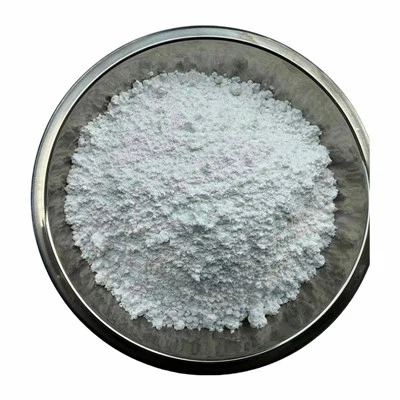


The refractive index is a fundamental optical property that describes how light propagates through a medium. In the context of Active Fused Silica Powder, understanding its refractive index is crucial for various applications, from optical components to high - tech electronics. As a leading supplier of Active Fused Silica Powder, I am excited to delve into this topic and share valuable insights.


Understanding the Refractive Index
The refractive index (n) of a material is defined as the ratio of the speed of light in a vacuum (c) to the speed of light in the material (v), i.e., (n=\frac{c}{v}). This value is a measure of how much a ray of light bends when it passes from one medium to another. A higher refractive index indicates that light travels more slowly through the material and is bent more strongly.
For Active Fused Silica Powder, the refractive index is influenced by several factors, including its chemical composition, density, and the wavelength of the incident light. Fused silica, also known as silica glass, is composed primarily of silicon dioxide ((SiO_2)). The high purity of our Active Fused Silica Powder ensures consistent optical properties, including a well - defined refractive index.
Refractive Index of Active Fused Silica Powder
The refractive index of fused silica is relatively stable and well - characterized. At a wavelength of 589.3 nm (the sodium D - line), the refractive index of pure fused silica is approximately 1.458. However, the refractive index of our Active Fused Silica Powder may vary slightly due to its specific manufacturing process and the presence of trace impurities.
Our production process involves carefully controlling the melting and cooling of high - purity silica to create a fine powder with uniform particle size and optical properties. This precision manufacturing results in a refractive index that is highly consistent across different batches of our Active Fused Silica Powder.
Factors Affecting the Refractive Index
Wavelength of Light
The refractive index of Active Fused Silica Powder is dispersive, meaning it varies with the wavelength of the incident light. This phenomenon is known as optical dispersion. Generally, the refractive index decreases as the wavelength of light increases. For example, at shorter wavelengths in the ultraviolet region, the refractive index of fused silica is higher than at longer wavelengths in the infrared region.
Temperature
Temperature also has an impact on the refractive index of Active Fused Silica Powder. As the temperature increases, the density of the powder decreases slightly, which in turn causes a decrease in the refractive index. However, the temperature coefficient of the refractive index for fused silica is relatively small, making it suitable for applications where stability over a wide temperature range is required.
Particle Size
The particle size of the Active Fused Silica Powder can influence its refractive index to some extent. Smaller particles may scatter light more effectively, which can affect the overall optical behavior of the powder. Our company offers a range of particle sizes, including 300 Mesh Fused Silica Powder, 400 Mesh Fused Silica Powder, and 600 Mesh Fused Silica Powder, each with its own unique optical characteristics.
Applications Based on Refractive Index
Optical Components
The well - defined refractive index of our Active Fused Silica Powder makes it an ideal material for manufacturing optical components such as lenses, prisms, and optical fibers. In lenses, the refractive index determines the focal length and the ability to focus light. Fused silica's low dispersion and high refractive index stability ensure high - quality imaging and minimal chromatic aberration.
Electronics
In the electronics industry, Active Fused Silica Powder is used as a filler in epoxy resins for encapsulating electronic components. The refractive index of the powder can be matched to that of the epoxy resin to improve the optical transparency of the encapsulant. This is particularly important for applications such as light - emitting diodes (LEDs) and optical sensors, where efficient light transmission is crucial.
Precision Instruments
Precision instruments often require materials with stable optical properties. Our Active Fused Silica Powder, with its consistent refractive index, is used in the manufacturing of interferometers, spectrometers, and other optical instruments. The high purity and low birefringence of fused silica ensure accurate measurements and reliable performance.
Quality Assurance
As a supplier of Active Fused Silica Powder, we are committed to providing products of the highest quality. Our quality control process includes rigorous testing of the refractive index and other optical properties. We use advanced optical measurement techniques, such as refractometry and interferometry, to ensure that our products meet the strictest industry standards.
Each batch of Active Fused Silica Powder is carefully analyzed to verify its refractive index and other key parameters. This ensures that our customers receive a product that is consistent in quality and performance, regardless of the quantity they order.
Why Choose Our Active Fused Silica Powder
- High Purity: Our Active Fused Silica Powder is made from high - purity raw materials, resulting in a product with minimal impurities and excellent optical properties.
- Consistent Refractive Index: Through our advanced manufacturing process, we ensure that the refractive index of our powder is highly consistent across different batches.
- Customizable Particle Sizes: We offer a variety of particle sizes to meet the specific needs of our customers, allowing for greater flexibility in different applications.
- Technical Support: Our team of experts is available to provide technical support and advice on the selection and use of our Active Fused Silica Powder.
Contact Us for Procurement
If you are interested in purchasing our Active Fused Silica Powder for your optical, electronic, or precision instrument applications, we encourage you to contact us for procurement discussions. Our dedicated sales team is ready to assist you in finding the right product for your specific requirements. Whether you need a small sample for testing or a large - scale supply, we can accommodate your needs.
References
- "Handbook of Optics", Third Edition, edited by Michael Bass, et al.
- "Optical Properties of Materials" by H. J. Hagemann, et al.
- "Silica Glass: Structure, Properties, and Applications" by P. W. Barber and R. K. Iler.